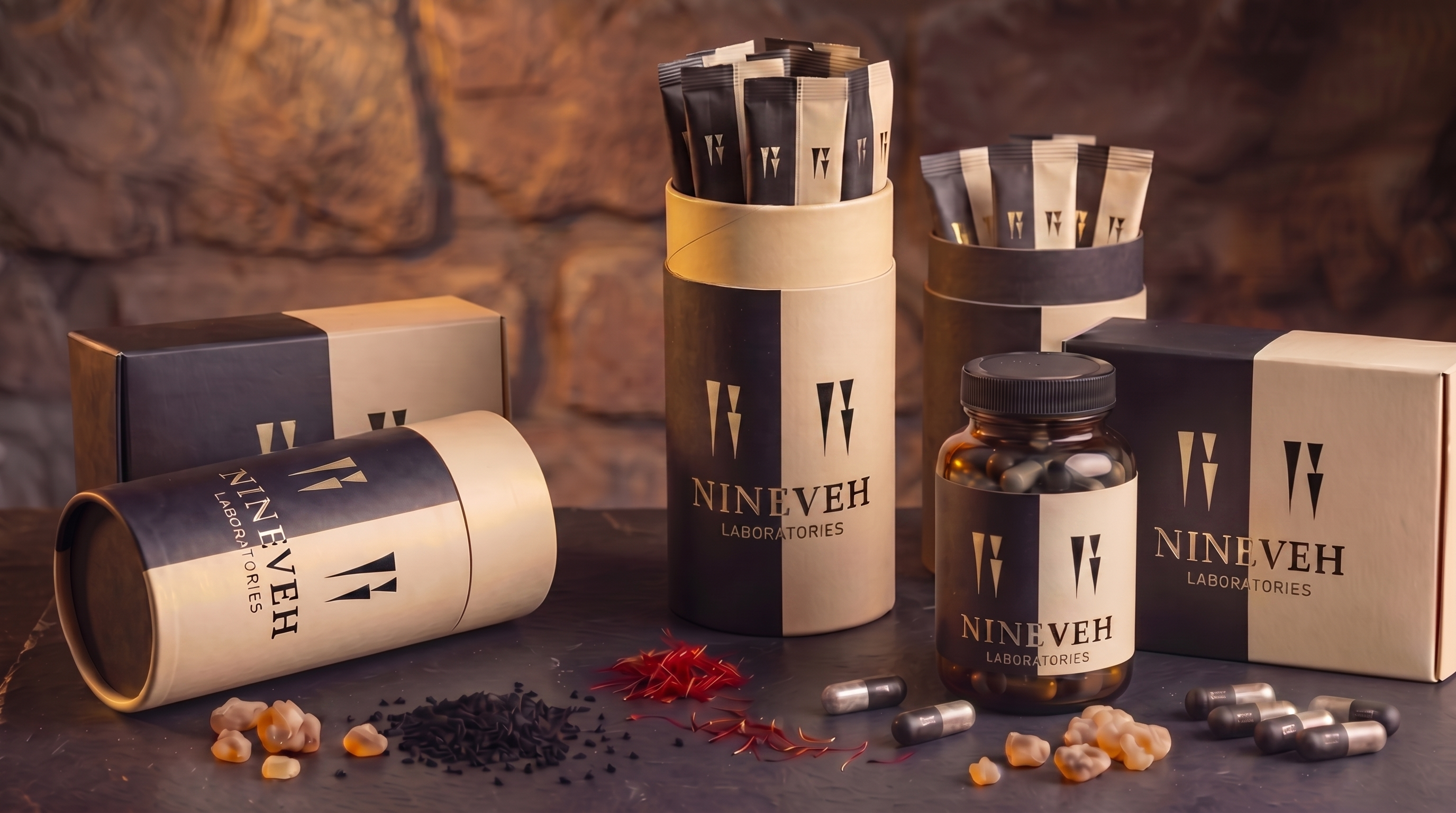
The Formula
Black seed — Nigella sativa — appears more frequently in Assyrian cuneiform medical texts than any other botanical. Identified by the Sumerian determinative ú (medicinal plant) and the Akkadian name anzanzaru, it was prescribed across dozens of tablets for respiratory conditions, skin disorders, and general vitality.
Our extraction is standardised to 3% thymoquinone, the active compound identified in clinical literature as the therapeutic threshold. Most commercial products deliver 0.5–1%. We do not compromise on dose.
A Remedy Across Every Age
Black seed carries a distinction held by almost no other botanical in recorded history: it appears, independently documented, across nearly every major civilisation of the ancient world.
The oldest written record belongs to Mesopotamia. Cuneiform tablets from the Library of Ashurbanipal — inscribed between 700 and 650 BCE and now held at the British Museum — name it anzanzaru, prescribed for respiratory complaints, skin conditions, and general vitality. It is the most cited botanical in the entire Assyrian medical corpus.
Ancient Egypt recorded it independently. A flask of black seed oil was found among the funerary objects of Tutankhamun in 1325 BCE. The Ebers Papyrus, dated to 1550 BCE, lists it among preparations for headaches and pain. The Greek physician Dioscorides, writing in the first century CE, called it melanthion and documented it for nasal congestion, headaches, and digestive complaints.
Recorded in Sahih al-Bukhari — the most rigorously authenticated collection of hadith in Islamic scholarship — the prophetic tradition of black seed shaped its use across the entire Islamic world for over fourteen centuries. It is among the most studied prophetic recommendations in modern pharmacological research.
More than 1,000 peer-reviewed studies have since investigated thymoquinone — the principal active compound in black seed — across anti-inflammatory, antimicrobial, immunomodulatory, and antioxidant pathways. Every civilisation that encountered this plant documented it. Nineveh returns to where the written record begins.
The Source
The cuneiform text this formula derives from was recovered from the Library of Ashurbanipal, Nineveh — the largest archive of the ancient world, containing over 30,000 clay tablets. Cuneiform scholars have spent generations deciphering them. We have spent years turning the botanical formularies they contain into products you can take today.
Read the full archive context →